
3.- TOLERANCE OF AMBIGUITY AND ITS
IMPLICATIONS FOR READING
Tolerance of Ambiguity and Its
Implications For Reading
Ruben Cardenas Cabello, Peru
Introduction
Time has shown us that there are a lot of
things that take place in our students’
minds when they are learning a new language, and what is more, they have to deal with the four skills: reading,
writing, speaking and listening. For instance, we could see in a group of
students of any level how some students easily grasp any explanation or application
of a point but it happens too, that there are some students who could not grasp
what the explanation was or what the use of a specific point was. However,
these students are desperately trying to learn a new language; they always find
lots of inexplicable things that interfere with their acquisition and therefore
we see how they lose interest and endfailing exams and simply dropping out of
courses. The main intention of this paper is to check how our EFL students deal
with ambiguity, if they tolerate it or not,
when they develop reading tasks in order to provide ideas and reflect on
our teaching methods and strategies when having reading sessions in EFL
classes.
What is tolerance of ambiguity?
Some quotes
Eherman says “Language learning for real communicative
is an extremely demanding whole-person engagement. It requires the learner to
cope with information gaps, unexpected language and situations, new cultural
norms, and substantial uncertainty. It is highly interpersonal, which is in
itself fraught with ambiguities and unpredictabilities. Language is composed of
symbols, which are abstract and often hard to pin down. Concepts and
expressions in any two languages do not relate one-to-one” (Ehrman, 1996). Given these complexities, it makes
sense that tolerance of ambiguity is crucial to success in language learning
aimed at a real communicative use. Students who lack tolerance of ambiguity
tend to have a great deal of trouble in language learning, both formal and
informal.
The learner makes discriminations, sets
priority among competing concepts, and develops hierarchies in terms of level
of abstraction. These activities usually entail integration of new information
with the existing schema to change the latter and make something new,that did
not exist before. “Jane Arnold with MadeleineEherman”
“The focus on affective variables in language
learning is reflected in attempts to reduce anxiety and inhibitions and to
enhance factors such as motivation and self-esteem. These factors are mostly
dealt with in humanistic type of education.”De Andres(2002)
“Humanistic education is related to a concern
for personal development, self-acceptance, and acceptance by others, in other
words making students be more human. Humanistic education takes into
consideration that learning is affected by how students feel about themselves.
It is concerned with educating the whole person - the intellectual and the
emotional dimensions.” Moskovitz (1978)
Where does tolerance of ambiguity
come from?
Owen and Sweeney (2000) note that Norton
(1975) found evidence that psychologists have suggested eight distinct
definitional categories for ambiguity which he includes in his definition of
intolerance of ambiguity as “a tendency to perceive or interpret information
marked by vague, incomplete, fragmented, multiple, probable, unstructured,
uncertain, inconsistent, contrary, contradictory, or unclear meanings as actual
or potential sources of psychological discomfort or threat” (Ely, 1995, p.
88). In general, “ambiguous situations
may be marked by novelty, complexity, insolubility, and lack of structure”
(Kazamia, 1999, p. 69).
The degree to which a person is cognitively
willing to tolerate ideas and propositions that are against the persons own
belief system or structure of knowledge marks the person’stolerance of
ambiguity. A person who is tolerant of ambiguity may enjoy creative
possibilities without being cognitively or affectively disturbed by ambiguity
and uncertainty; so such a person can deal with uncertainty fairly comfortably,
while a person who has a low tolerance may become anxious and frustrated when
encountering a task with new, unknown elements that seem ambiguous or difficult
(Hadley, 2003). According to
Larsen-Freeman and Long (1991), people with low tolerance of ambiguity may
experience frustration and diminished performance, may appeal to authority, for
example to request a definition for every word of a passage, they may also
prefer to categorize phenomena and tend to jump to conclusions. Budner (1962, cited in Johnson, 2001) states
that ambiguous situations are sources of threat for those who are intolerant of
ambiguity. In learning a second
language, there are many occasions when apparently contradictory information is
encountered such as words, structures and rules, even the culture.
Tolerance of ambiguity in reading
Much has been written about this skill, mostly
stating it is a passive skill. However, life and classroom experience has
proved the opposite. We can say now, that it is a very active skill, since it
makes the reader think and activate a lot of mechanisms in order to process
information. Rebecca Oxford says that “
For the adult ESL learner, reading is a key to success in higher education.
Without reading opportunities for understanding the
United States and achieving educational
objectives are lost”. She also remarks that “reading competence does need
grammatical competence, sociolinguistics competence, strategic competence and
discourse competence.”
David
Nunan says “Unlike speaking, reading is not something that every
individual learns to do. An enormous amount of time, money, and effort is spent
teaching reading in elementary and secondary schools around the world. In fact,
it is probably true to say that more time is spent teaching reading than any
other skill.” Taken from (Second Language Teaching & Learning, David
Nunan1999, Page 249.)
Patricia Carrel and Joan C. Eisterhold mention
that Goodman has described reading as a “psycholinguistic guessing game” (1967)
in which the reader reconstructs, as best as he can, a message which has been
encoded by a writer as a graphic display” (1971). Jeremy Harmer says that
understanding a piece of discourse involves much more than just knowing the
language. In order to make sense of any text we need to have pre-existent
knowledge of the world (coo 1986:69). Such knowledge is often referred to as
schema (plural schema). Each of us carries in our heads mental representations
of typical situations that we come across. When we are stimulated by particular
words, discourse patterns, or contexts, such schematic knowledge is activated
and we are able to recognise what we see or hear because it fits into patterns
that we already know.
Tolerance of ambiguity in reading.
When reading takes place in any class teachers
may notice fast that something is going
on our students’ minds. We can see it in their eyes and faces. To get more
information about it let us read the
following important information. “ what
If in reading a sentence a reader finds something unfamiliar in lexical
meaning or grammatical structures, the meaning of the written material may be
ambiguous to him. Sometimes the context will help to clarify the meaning of an
unfamiliar element, but often it won't. Understanding what is read involves not
only the process of reasoning, but also the process of eliminating ambiguity.
In this study of students' comprehension of sentence structure, it was found
that many intermediate grade students (grades 5-8) had difficulty recognizing
sentence transformations with equivalent meanings. They also had difficulty
recognizing the kernel sentences of larger sentences. The study indicated that
there was a wide range in the abilities of the students to recognize sentence
transformation with equivalent meanings and kernel sentences of larger
sentences. A teacher can help students increase their understanding of sentence
structures by exploring with them the various ways in which the same concept
can be stated. Teaching the equivalency of one structure to another can be used
as a basic method of expanding students' understanding of the literal meaning
of various types of sentence structures whether the structures are
infrequentlyused, highly complicated, nonstandard, or ambiguous standard
English sentences.
Levels of tolerance of ambiguity
Ehrman (1996, 1999) considers three levels of
function for tolerance of ambiguity; they include: 1. Intake, that is letting
in the information into ones’ conceptual schema; 2. Tolerance of ambiguity
proper which is the stage to deal with contradictions and incomplete
information or constructs; and 3. Accommodation, that is integration of new
information with existing schemata to make distinctions, set priorities, and
restructure cognitive schemata. This
third level is in its most effective state when the learner displays
considerable tolerance of ambiguity and the capacity to cope with strong
feelings provoked by experiences that seem to assault the person’s construal of
the world and the self.
In language learning, in facing too much new information
and contradiction, the learner is led to strong affective reactions, either
positive or negative based on the success of the accommodation. In some cases, limiting cognitive capacity or
setting up barriers to new input occurs.
This in fact can be an affective source of certain thick boundary
behavior. Ego boundaries which are
flexible are related to tolerance of ambiguity in that they are associated with
“disinhibition and potentially to openness to unconscious processes; they tend
to promote empathy and the ability to take in another language and culture”
(Ehrman, 1999, p.76).
Eherman notices “Tolerance of ambiguity is
made of three levels”
- Intake (Letting it in)
- It permits information to enter to one’s
conceptual schema in the first place; thick ego boundaries can interfere at
this level (especially external ones)
- Tolerance of ambiguity:(Accepting
contradictions and incomplete information)
- Intake has been successfully accomplished,
necessitating that the learner deal with contradictions and incomplete
information or incomplete constructs. This is often very difficult for
thick-boundary learners.
- Accommodation: (Making distinctions, setting
priorities, restructuring cognitive schemata)
Applications
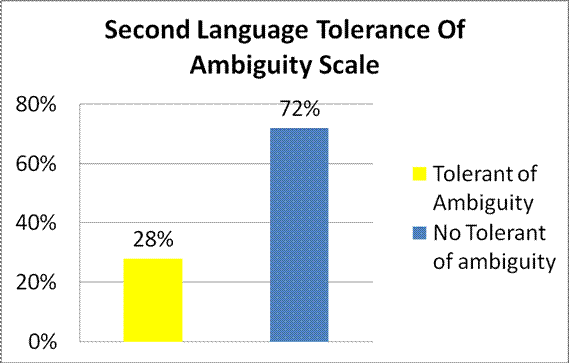
As I wanted to confirm the corresponding
implications to tolerance of ambiguity, and its implications in reading. I
decided to apply a questionnaire on ‘Second language Tolerance of Ambiguity
Scale (by Christopher M Ely Department of English College of Sciences and
Humanities Ball State University) to 25 students, age from 14 to 31. These
students, who have been studying English at the Language Centre for more than 2
years in a 10 hour intensive course, are from different backgrounds and
specialties. We have obtained the following results:
Comments
As we can see 72 % percent of students do not
tolerate ambiguity when developing reading tasks in class. Which is, obviously,
giving us a clear idea on what really happens when our students read texts.
That is why, we see how students lose interest, and what is more, develop a
kind of negative attitude when reading. We have also seen that students are
desperately trying to use different strategies to get over these frustrating
moments; for example, they stop reading to
look up new words in order to understand or simply ask a classmate,
interrupting, not only, the idea of the text but also the other student too.
According to the results obtained from
the questionnaire ‘Second language
Tolerance of Ambiguity Scale (by Christopher M Ely) We can say that our
students do have problems at the moment of developing reading tasks in class
and it’s the teachers’ role to look for new strategies and methods to make
reading tasks much more meaningful.
Implications
A. Implications for EFL Teachers
EFL learners study English for different
porpuses. Some will travel, others need it for their university studies, and a
lot of students need it to have more opportunities at work. How it might
implicate on the work of teachers in EFL classes? We can say that the kind of
participants teachers have in class is totally multiplural. We mean that what
students bring to the classroom is varied. For instance, some students have
read a lot in their mother tongue, a lot of
them haven’t read much, and a few
students like reading. So the background students have is too little and it
does not help them when reading, apart from that it is a trouble the vast
vocabulary that the second language has.
So teachers roles in class is really
challenging since they have to take into consideration a lot of aspects. And
one simple thing is to know our students. I mean to get information about their
studies, goals and learning styles.
B. Implications for Language
Instruction
We should consider the following implications:
1. Assess students’ background on reading. (mother tongue).
2. Consider the multiplural realities.
3. Choose and adapt reading strategies.
4. Evaluate the use of other resources to help
understanding while reading.
5. Test students’ motivation for reading.
Conclusions
The results obtained above suggest that the
majority of the students,72%, do not
tolerate ambiguity when reading. And in terms of classroom practice, this work
has the following implications.
First, we must be aware of the little
background our students have concerning to reading, which is why, they usually
struggle.
The well-known reading strategies seem not to
solve students problems when reading.
Luck of tolerance of ambiguity does create
really trouble to learners when reading.
Suggestions
Promote reading as much as possible.
Assist learners when reading in order to know
more about their ambiguity and be able to help them.
Pilot new strategies and methods in order to
lessen students ambiguity.
Consider that reading is a really active
skill, so that you must be ready to face students’ troubles.
References
Arnold Jane and Eherman Madeleine. 1999.
Affect in Language Learning .
Pages . 68, 69, 74, 76, 78 and 84.
Scarcella Robin C. and Oxford and Rebecca L.
1992. The Tapestry of language learning,
Page 93 .
Nunan David 1999. Second Language Teaching
& Learning. Page 249.
Long H. Michael and Richards Jack C. 1987.
Methodology in TESOL. Page 219.
Harmer Jeremy
2001. The practice of English Language Teaching. page 199.
Ely Christopher. 1995. Learning Styles in the ESL/EFL Classroom.
Pages 87, 88, 89,90,91, 92, 93 and 94.
The Methodology and Language for Secondary
Teachers course can be viewed here.
http://teachers.pilgrims.co.uk/teachers/courses/date_fees.asp
The Teaching Advanced Students course can be
viewed here.
http://teachers.pilgrims.co.uk/teachers/courses/date_fees.asp
About the Author
Rubén Cárdenas Cabello is an English teacher at USIL
University in Lima, Peru. He is interested in developing tasks, approaches and
activities to teach English as a foreign language. He has created a lot of
materials and has run seminars in Peru. His current interests are how to teach
grammar using pictures, and how to face ambiguity in classes while developing
reading tasks. E-mail: rubenteacherstalk@hotmail.com
© Guardian News and Media Limited
2011
------------------------------------------------------------------------