SHARE
An
Electronic Magazine by Omar Villarreal and Marina Kirac ©
Year 8
Number 177 June
16th 2007
12,337 SHARERS are reading this issue of SHARE this week
__________________________________________________________
Thousands of candles can be lighted from a single candle, and the life of the
candle will not be shortened. Happiness never decreases by being SHARED
__________________________________________________________
Dear SHARERS,
It always feels really good to write a new issue of
SHARE for all of you even in these busiest of times when we are fixing
everything for our own big event of the year:
the Annual SHARE Convention. An impressive roster of
26 semiplenarists and ten participants in 2 round tables will assemble this
year to SHARE their talent and
expertise with you. So, put it down in your diaries:
Thursday 2nd and Friday 3rd of August (the last two days
of the winter recess in the city and the province of Buenos Aires) at “Los Dos
Chinos” Hotel in the city of Buenos Aires.
Our graphic designer (now, with the new format, an
indispensable part of the foursome staff that make SHARE) is overloaded with
work: posters (mail and paper varieties), the regular SHARE issue and the
Convention Website on which he is avidly working. It is not finished yet but
you can access it in its embryonic form at: http://www.shareeducation.com.ar/2007/elt_horizon/index.htm
Now, on a more personal note, this year´s Convention
will be dedicated to the loving memory of our very dear friend and staunch
SHARE supporter Susan Cantera who passed away last month after a terrible
illness. Her last days were filled with peace and, paradoxically enough, hope
and we could say that she died the way she had lived all her life: a devout
believer and quiet and loving friend of most of those who had the gift of
sharing a part of her life. Her “New Ways
to Opportunities” ELS in Ringuelet,
Love
Omar and Marina
______________________________________________________________________
In SHARE 177
1.- The
issue of interlanguage pragmatics and the young foreign language learner in
2.-
3.- Advanced Vocabulary in Context: Food Stuff and Cafes.
4.- Jornadas de Lenguas Extranjeras de
5.- Carrera de Posgrado en Enseñanza del
Español en Universidad Nacional de
6.- Universidad Nacional de Tucumán: Jornadas
de Lectura y Escritura.
7.- Postgraduate Courses at
Universidad Nacional de Córdoba
8.-
First Conference on
English-Speaking Countries´ Cultural Studies
9.- San Luis: 1ª Foro Provincial de Lectura y
Escritura
10.- IV Jornadas Virtuales Instituto Superior del Profesorado
“Dr. Joaquín V.
González”
11.- Seminar: Great Mid-Year Activities
12.- Teacher Development: The Helbling
Day
13.- Talking Time at INSPT – Universidad Tecnológica Nacional
14.- Online Course on Prepositions and Phrasal Verbs
15.- III
International ELT Forum “Sharing Ideas and Knowledge”
16.- Further Certificate for Teachers of Business
English
17.- The
18.- Seminar on English through popular music
19.- A New Issue of E-Teaching Online
20.- ECL Tour of
21.-
Feria Expolenguas y Cultura 2007
22.-
XXXII FAAPI Conference in
------------------------------------------------------------------------

1.- THE ISSUE OF
INTERLANGUAGE PRAGMATICS AND THE YOUNG FOREIGN
LANGUAGE LEARNER IN
We proudly
present to all SHARERS this article submitted to us by its authors,our
distinguished colleagues: Liliana Berardo, Elisabet Caielli, Ana Lía Regueria and
Jenifer Williams
from Universidad Nacional de Mar del Plata.
The
issue of interlanguage pragmatics and the young foreign language learner in
Abstract:
The present study is concerned with
the field of interlanguage pragmatics. It aims at examining whether learners
are able to perform the speech acts of requesting,
describing and expressing likes and dislikes after three years of instruction in
English at school (EGB 2 level- Province of Bs. As.). Data were obtained by
means of role plays. In spite of the fact that learners had a positive
disposition towards the study, which was crucial for the development of the
conversations, the results show that most of them could not perform the
required speech acts successfully. This could be due to lack of instruction in
questions of pragmatics and, most probably, to lack of opportunities for oral
communication during instruction.
Introduction
Second language
acquisition (
Investigations deal with several aspects that relate to teaching and learning languages and, many times, try to provide useful information to understand and improve both processes.
One of the areas
covered by
the study of learner’s errors
the study of developmental sequences
the study of variability
the study of pragmatics features
The objective of this study is to
examine interlanguage from the perspective of pragmatic features. Pragmatics is “the study of the use of
language in communication, particularly the relationships between sentences and
the contexts and situations in which they are used.” (Richards et al. 1992)
According to Faerch and Kasper, pragmatic knowledge is “(…) a particular
component of language users’ general communicative knowledge, viz. knowledge of
how verbal acts are understood and performed in accordance with a speaker’s
intention under contextual and discoursal constraints.” (Faerch and Kasper,
The teaching of English in a
foreign language setting poses several difficulties for the development of
pragmatic competence, since the lack of contact with a native speech community
and scarcity of opportunities for using the language in real-life situations
hinder the development of a competence that accounts for authentic use of the
foreign language. Considering non-native use of language, Kasper (
Kasper and
Blum-Kulka (
Studies carried out in the field of ILP suggest that there are three salient factors in the acquisition of pragmatic competence. The first relates to the level of the learners´ linguistic competence since limited proficiency hinders native-like performance. Learners with a low proficiency may perform some speech acts that are communicatively important to them but find it difficult to perform them in native-like ways.
The second factor is transfer , which refers to the influence that previous pragmatic knowledge of languages and cultures other than L2 has on the acquisition and use of L1 rules of speaking in a L2 situation. Rather, it should be understood as a complex process where what is transferred and under what circumstances should be considered carefully.
The third factor refers to the status learners adopt in the communicative events in which they take part. The fact that they are learners implies that they have a reduced status in reference to a native-speaker, or a teacher, i.e. somebody who possesses the knowledge that they lack, and, therefore, they are likely to have less opportunities to compete for turns or nominate topics. According to research mentioned in Ellis (reference), this restricts the range of speech acts learners perform.
Considering what has been discussed so far, it may be assumed that learners who have had little exposure to the foreign language, who have a low level of proficiency and who have had few opportunities to participate in real or life-like communicative events will be at a low level of ILP development. Developing pragmatic competence in learners requires careful planning and resources (video and tape recorders, TV sets, reduced number of students per group, etc.) in order to create the appropriate environment where learners increase their linguistic competence, learn to make positive transfer and become aware of how the study of a foreign language may influence their language acquisition processes, and gain confidence to place themselves in a more equal status with native speakers or fluent users of the language.
Problem definition
From observations in our teaching situations and as teachers of the Teacher Education Area, Profesorado de Inglés, UNMdP, tutoring student teachers, we have become concerned with the fact that learners who have been exposed to the first three years of instruction in English as a foreign language within the framework of the curriculum for the Province of Buenos Aires have made little progress in their interlanguage development. This progress does not seem to parallel the contents listed on the curriculum, and this is evident to anyone involved in the profession.
Which are, in fact, the contents that learners have been able to acquire? In particular, which speech acts are they able to perform? Is it possible to describe the pragmatic competence learners have developed at this point? Can pragmatic competence be taught? These are only some of the questions that arise as we begin to look at this situation. We have chosen to investigate speech acts in an attempt to limit interlanguage to only one component of communicative competence and because it is of our interest to analyse the extent to which our students can actually put language to use.
The problem we put forward spreads over a number of areas: second language acquisition, the study of pragmatic features of learner language, the role of instruction, the state policy for teaching a foreign language, the teaching context and even the teaching profession. It is not our intention to analyse all of them in this paper but, as with many other phenomena, there is usually an interaction of factors at play. How the areas are relevant to this work will be considered in other sections of this paper.
Justification
There has been wide research in
the history of
Theoretical framework
As stated before, the aim of this paper is to examine our students´ pragmatic competence. This involves a consideration of what pragmatic competence actually involves. Bachman (1990:90) discusses the notion of pragmatic competence to include “ (…) illocutionary competence, i.e. the knowledge of the pragmatic conventions for performing acceptable language functions, and sociolinguistic competence, or knowledge of the sociolinguistic conventions for performing language functions appropriately in a given context.” He continues to relate illocutionary competence to Speech Act Theory, according to which utterances can be analyzed as utterance acts, which is simply the act of saying something; propositional acts, involving referring to something or expressing a prediction about something; an illocutionary acts, which is the function performed in saying something. Speech acts are, then, utterances seen as functional units in communication which have a propositional or locutionary meaning, an illocutionary force and a perlocutionary effect on the hearer/ reader. Yule (1996) argues that of these three dimensions, the most discussed is illocutionary force, which is what an utterance “counts as”.
Ellis (1994) explains that there are two things that can be distinguished when a speaker performs an utterance in context: an interactional act and a speech act The former aims at providing structure on the discourse, thus being concerned with how users manage turn-taking mechanisms, how they open and close conversations, etc. The latter refers to specific actions performed by speakers such as compliments, requests, or complaints.
For the purpose of this paper we will adopt what Kasper and Dahl (1991) refer to as the “narrow sense” of interlanguage pragmatics, that is, the performance and acquisition of speech acts by L2 learners. Other interactional acts such as conversational management and discourse organization are not included in this “narrow sense”.
Review on the research methods used for studying illocutionary acts refers to Kasper and Dahl (1991), who distinguish data collection methods according to the way in which data are elicited (perception/ comprehension / intuition versus production). In the case of learner’s production, the following instruments have been used: discourse completion tasks, role-plays and naturally occurring speech. Discourse completion tasks make use of questionnaires. In role-plays learners are asked to respond orally. Naturally occurring speech has been less common since it is difficult to gather a sufficient corpus of data. In general, research has made use of spoken data collected in natural settings, and also data elicited by means of discourse completion tasks. Learners have been found to make sociopragmatic errors and pragmalinguistic errors.
According to Thomas (1983), sociopragmatic failure takes place when a learner fails to perform the illocutionary act required by the situation and pragmalingusitic failure occurs when a learner tries to perform the right speech act but uses the wrong linguistic means.
Ellis (1994) summarizes some of the studies that have been carried out
in the field of ILP, which have focused on a small set of well-defined
illocutionary acts. These are: requests, apologies and refusals. Within the
scope of this paper, the speech acts studied will those that are part of the
curriculum for the
In the “Diseño Curricular. Educación Inicial. Educación General Básica” (2001)
corresponding to the
· Actos del habla: saludar, presentarse,
expresar edad, identificar, describir, localizar sitios, pedir, agradecer,
expresar gusto y desagrado, aceptar, rechazar, narrar, planificar, opinar.
Students are to perform these speech acts at
the end of the 6th year of EGB. In the same document we find, among others, the
following attainment targets (expectativas
de logro) for the same period of schooling:
· Reconocimiento
de la función comunicativa de un mensaje en un contexto familiar.
· Producción
oral en intercambios básicos, con fonética y sintaxis aproximadas a las
correctas.
Having this framework in mind, we set out to
design the method to carry out the investigation.
Limitations:
It can be gathered from the above discussion
that the study of ILP is a complex issue. The many aspects involved in the
process of acquisition and performance of pragmatic competence impose
limitations on any research study. Performance cannot be interpreted as the
direct realization of competence, and there are also contextual, cognitive,
psychomotor and external factors that influence an individual’s use of
language. Creating the necessary conditions for investigating ILP is not an
easy task, and research findings should always be interpreted within these
restrictions. As stated in the introduction to Researching Pedagogic Tasks.
Second Language Learning, Teaching and Testing, “… the challenge will be to
propose research methodologies which can enable internal processes to be
addressed through external, publicly analyzable evidence.” (2001: 8)
Method
The subjects for the present study were
learners from state or private schools in
The data collection instrument was
role-play, since the modality under study was oral production. The role-play
involved the learner and the researcher. Two researchers performed as
interlocutors. They explained the situation for the role-play in L2 and
tape-recorded it for later analysis. Considering that the situation was new to
the learners and that the researchers were not regular teachers at the school,
factors that might have inhibited learners’ performance, it was decided to give
learners five minutes’ preparation time during which they had three role-cards
that briefly explained the situations. (Appendix 2)
As regards the language functions
selected, they were: requests, descriptions, and likes and dislikes. They were
chosen on the belief that they are usually dealt with by teachers in the
classroom situation. Our experience as tutors of student teachers confirms this
view since these functions always appear as teaching points assigned to trainees
by the teachers at schools. The functions are also part of the contents of the
curriculum for the
It was also agreed to implement a
piloting experience. The main concern was to adjust the researcher’s linguistic
participation during the conversation with the learners. Four subjects were
chosen at random for this experience and two researchers performed as their
interlocutors. Instructions and explanations about the situations were given in
L2 and learners had no difficulty in understanding. They were also enthusiastic
about their contributions which made our task as interlocutors much easier to
perform. Nevertheless, on listening to the tape, we discovered that our
participation tended to be teacher-oriented and so adjustments were needed. It
was agreed to reduce the number of questions asked and to avoid praising. These
two features gave the exchanges the characteristic of classroom discourse. We
also discussed the fact that we wanted to avoid long periods of silence since
we thought this could be discouraging for the learners.
Analysis
of data
Table 1 shows the number of learners who could
or could not perform each speech act. Out of the thirteen participants, three
performed the three speech acts, seven did not perform any of the three, and
three performed only one or two. There was no significant difference between
boys and girls.
Table 1
|
STUDENTS |
REQUESTS |
DESCRIPTION |
DIS/LIKES |
|
|
|
|
|
|
1 |
NO |
NO |
NO |
|
2 |
YES |
YES |
YES |
|
3 |
YES |
YES |
YES |
|
4 |
NO |
YES |
NO |
|
5 |
NO |
NO |
NO |
|
6 |
NO |
NO |
NO |
|
7 |
YES |
YES |
YES |
|
8 |
NO |
NO |
NO |
|
9 |
YES |
NO |
YES |
|
10 |
YES |
NO |
NO |
|
11 |
NO |
NO |
NO |
|
12 |
NO |
NO |
NO |
|
13 |
NO |
NO |
NO |
|
|
|
|
|
The speech acts were recorded as being
performed when the grammar, vocabulary and pronunciation were acceptable for
the context of situation and the whole illocutionary act was clear. Also, the
whole interaction was considered, including the learners’ disposition to keep
the conversation going. This disposition can be defined in terms of tone of
voice, readiness to answer, use of L1 or L2 and even physical attitude.
In the case of requests, the following forms
were used by the participants to convey meaning: I’d like …, a hamburger and a coke, please, and My order is …. Eight out of the thirteen
learners could not perform this speech act, which implies 61, 54 % of the total
number (Table 2)
The forms used for descriptions were: My bedroom is…, It has …, It is …. Vocabulary
items used were: posters, bed, carpet,
window, and colors. The only
adjectives mentioned were big and beautiful. Nine participants, 69, 23 %,
did not perform the speech act while four did, 30, 77 %. (Table 2)
As regards likes and dislikes, two learners
used I like…, while another said My favorite …, and My music prefer …. Then, names of programs or channels were
mentioned and types of music. Again, nine of the participants did not perform
the speech act. (Table 2)
Table 2
|
REQUESTS |
8 |
NO |
61,54% |
|
|
5 |
YES |
38,46% |
|
|
|
|
|
|
DESCRIPTION |
9 |
NO |
69,23% |
|
|
4 |
YES |
30,77% |
|
|
|
|
|
|
DIS/LIKES |
9 |
NO |
69,23% |
|
|
4 |
YES |
30,77% |
Discussion
of results
Results show that the learners performed much
better than expected considering the situation. Three of the teachers
participating in the study do not belong to the school where the study was
carried out, and were strangers to the learners. The only teacher who works at
the school did not participate in the data collection stage. We had assumed
that the learners would feel much more inhibited by the situation than what
they really were, and that they would be less able to cooperate with the study.
However, as regards the learners’ production of
the selected speech acts, the results show that most of the participants could
not perform them (see Table 2) Most of the learners could not perform the
actions required by the context of situation and they could not give the right
illocutionary force to their utterances due to lack of linguistic means. Their
errors were of a pragmalinguistic nature.
Our assumption is that they had received no
specific instruction in pragmatics, and that what they could do was the result
of transfer of pragmatic universals (Kasper, 1997). Some of the learners could
respond to the situations by making use of vocabulary items appropriate for the
situations, thus showing that they could understand what was expected of them.
We can say that there was “pragmatic comprehension”, but we assume that their
productions were not the result of previous instruction.
As mentioned above, research shows that
learners with a low level of proficiency in the foreign language find it
difficult to perform speech acts in native-like ways. However, in this case,
most of the learners could not perform them at all, which may be a sign of very
low linguistic competence, hence the assumption of poor previous instruction.
Below, we set to explain our assumptions in reference to each speech act.
Appendix 3 consists of the transcripts of the role-plays carried out with four
of the learners, which could serve as a source of reference.
Request is the speech act that most
commonly appears in classroom discourse, so we had expected a greater variety
of forms used by the learners. However, only one learner used “I’d like…”,
while two just said “A hamburger and a Coke”, and only one of them said
“please”. Another participant said “Give me please a hamburger and a coke”. It
is surprising that they could not transfer other forms for performing requests from
classroom discourse. Even though classroom discourse has a unique structure and
it does not offer nonnative speakers what they need to communicate in the world
outside (Kasper, 1997), it is a valuable source of opportunities for pragmatic
learning when performed in the L2. We could say that there was no
“intralanguage” transfer, probably due to the fact that the learners had not
received enough exposure to classroom language in L2.
In the case of Descriptions, the results show the use of a limited number of forms
again. It may be assumed that learners could have had some forms available,
such as “There is/are” or “It has got”, but they did not appear at all. A few
items of vocabulary were enough for the learners to participate in the
conversations, which is coherent with some of the studies in
As regards Likes
and dislikes, the issue of vocabulary was again present. Those learners who
could perform the speech act made use of a limited variety of structures, such
as “I like…” or “My favourite…” In most cases, mentioning the names of actors,
TV programmes or types of music was enough to keep the conversations going, but
there was no evidence that the learners could perform the required speech act.
The learners’ degree of involvement and disposition
to participate actively in the conversations was crucial to decide if the
speech act had been performed or not. Cooperation is one of the principles that
guide real life interaction, as proposed by Grice in 1975 (Hatch, 1992), so
being able to show some degree of cooperation within the appropriate framework
of each situation, was considered as a sign of pragmatic competence.
Conclusion
The study presented here sought to
investigate whether learners who had received instruction for three years in
state school settings had developed some kind of pragmatic competence. In order
to do this, data was collected by means of role-plays, to see if the learners
could perform the speech acts of requesting, describing and expressing likes
and dislikes in three given situations.
The results show that the ILP level of
the participants is still rather low after three years of instruction. More
research is needed to explore whether it is possible for learners to develop a
higher level of pragmatic competence in the same conditions, and what kind of
instruction might be appropriate.
So far, this study shows that a different
approach is needed if we want learners to become communicatively competent in
English under the present conditions. The fact that the participation of most
of the learners in the conversations was rather basic or null might be the
result of deficient instruction and little exposure to the L2.
Undoubtedly, ILP is difficult to study in
foreign language contexts since it is impossible to attain the authenticity of
real life situations in order to measure the extent to which learners handle
different speech acts. Most of the studies carried out in this field make use
of completion tasks or production questionnaires which are written elicitation instruments
for which learners are asked to select options to complete a written
conversation. In this study, though, we made an attempt at eliciting data
through role-plays with the aim of recording whether the participants were able
to perform the selected speech acts.
The method of data collection posed some
limitations, especially in relation to attitudes both of the learners and the
researchers/interlocutors. On the one hand, the question of reduced status
mentioned by Ellis (1994) was hard to handle. It was clear that the learners
could not forget that their interlocutor was a teacher and this hindered their
spontaneous participation in the conversations.
On the other hand, the interlocutors had the
difficult task of making participants feel at ease, confident and understood,
while at the same time trying to simulate a real life interaction. In their
attempt to elicit information from the learners and to approximate to a real
life situation, the researchers’ language resulted somehow artificial at times.
If we had the chance of continuing the study, we
would interview the learners again to obtain more specific information about
their background. Also, we would supplement the data with a production
questionnaire in order to compare results. After doing the study we realized
that the data obtained was somewhat limited, and that many of our conclusions
may be more the result of speculation than of interpretation of findings. Lack
of time was also a drawback in some respect. However, all in all, the experience
was fruitful since it offered the opportunity of exploring an area of English
language teaching that is usually neglected.
References
- Bachman,
L. 1990. Fundamental Considerations in
Language Testing.
- Batstone, R. 1994. Grammar.
- Bygate, M., P. Skehan and M. Swain (Eds.).
2001. Researching Pedagogic Tasks.
Second Language
Learning, Teaching and Testing. Essex: Pearson
Education Limited.
- Diseño
Curricular. Educación Inicial. Educación General Básica. 2001. Ministerio de Cultura y Educación de
- Ellis, R.
1994. The Study of Second Language
Acquisition.
- Faerch
and Kasper.
- Hatch, E.
1992. Discourse and Language Education.
- Kasper,
G. 1997, “Can Pragmatic Competence be Taught?” in
- Richards,
J, J. Platt and H. Platt. 1992. Dictionary
of Language Teaching and Applied Linguistics. (Second edition)
-Yule, G.
1996. Pragmatics.
Appendices
Appendix 1: Survey
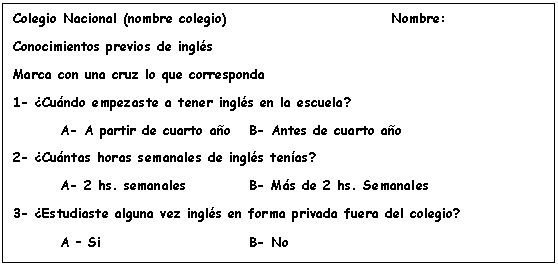
Appendix 2: Role-cards



Appendix 3: Transcripts
STUDENT NUMBER 2:
- Conversation 1: Requests
A: Good morning
B: Good morning
A: Are you ready to order?
B: Yes.
A: Yes, what would you like?
B: I’d like (.) a Mc Combo with
A: Mc Combo? OK Mc Combo
B: Cheese.
A: With chips? Or Cheese? With chips, with
chips.
B: “Uh” Coca Cola.
A: Coca Cola
B: With ice.
A: With ice, I see. Large or small Coca cola?
B: Small.
A: Small Coca cola, I see. OK. Mc Combo with
chips and small Coca cola with ice. Right?
B: Yes
A: Ok Here you are. That’s “uh” four dollars.
B: (2.0) [giggle] Thank you.
A: You’re welcome.
-
Conversation 2: Description
A: What is your ideal bedroom like, Dana?
B: “Uh”
A: Aha? The walls are orange and violet? Wow! I
LIKE THAT.
B: With (.) violet carpet
A: Wow! GREAT.
B: “Uh” With stars
A: With stars. Where? On the ceiling?
B: Yes.
A: Oh, I see, stars. How nice! Violet is your
favourite colour?
B: With orange
A: And orange. And orange.
B: The two.
A: Both of them. I see, I see. Good.
B: And, “uh”, a window with /si:/
A: A window?
B: ( ) /si:/
A: Oh, a window looking at the sea! Oh, how
nice! I love that!
B: And a desk.
A: And a desk, I see.
B: Biblioteca, ¿cómo se dice?
A: A bookcase, you mean a bookcase.
B: Yes
A: Oh, I see. Good. And, let’s see, can we see
a computer in your bedroom?
B: Yes.
A: Yes, probably. And posters on the walls?
B: Mmm, [giggle]
A: No.
B: Maybe.
A: Maybe, maybe. Alright, I LOVE that bedroom.
I really like it. Orange, violet, the floor with a violet carpet … Lovely,
lovely.
-
Conversation 3: Likes and dislikes
A: What kinds of music do you like, Dana?
B: I like pop
A: Pop music? Aha?
B: Rock
A: Rock as well. Argentine rock, American rock,
British rock?
B: All.
A: OK. All kinds of rock. I see. And do you
have a favourite singer?
B: “Uh” Shakira
A: OK. Yes I like Shakira too.
B: And La oreja de Van Gogh.
A: La oreja de Van Gogh … I LOVE THAT ONE . Yes. Do you have a favourite song by La oreja de Van
Gogh?
B: “Uh” Rosas.
A: Rosas. Oh yes, I like that one too. Alright. La
oreja de Van Gogh, they are coming to
B: Yes, Moon Park.
A: Yes, you are right. They are coming to the
B: ( )
A: No.
B: No ( ) all.
A: All, all, I see. And, tell me something about TV programmes.
Do you have any favourite TV programme?
B: Yes. “Uh” Discovery Channel
A: Discovery Channel. Oh, the channel as such.
B: Yes.
A: Discovery Channel. And do you have a
favourite programme in the Discovery Channel?
B: People and Arts.
A: People and Arts? It’s another channel?
Right? Or not?
B: ( )
A: Ah, it’s a programme?
B: It’s a channel.
A: It’s a channel. Discovery channel, People
and Arts
B: Animal planet.
A: Animal planet, I see.
B: And Discovery ( )
A: Oh, I see, I see. And, do you have any
favourite TV programme from
B: “Uh” In the Channel Disney, Art Attack.
A: Oh! Art Attack. Oh, yes. My daughter likes
that. I like it too. Yes, good.
B: And (.) What not to wear on People and Arts.
A: Oh, yes. I like that one. The one in which
they change the rooms and they change the bedrooms, while you are not
B: This is change your rooms, the other is What
not you wear.
A: Oh! Ah, yes, you are right
B: It’s the People and Arts.
A: You’re right. I like that one too. I usually
watch that one. Good.
STUDENT NUMBER 4:
- Conversation 1: Requests
A: Good morning. Can I help you?
B: (3.0)
A: Are you ready to order?
B: (3.0)
A: Would you like a hamburger?
B: Yes.
A: Yes, OK. A hamburger with cheese?
B: Yes.
A: So a cheeseburger and … to drink?
B: Coca cola.
A: Coca cola, I see. Large or small Coca cola?
B: Large.
A: Large Coca cola. So a cheeseburger and a
large Coca cola. All right. Here you are. That’s five dollars, please.
B: (.)
A: Thank you. Oh, here’s your change.
B: Thank you.
A: You’re welcome. Bye bye.
-
Conversation 2: Description
A: What is your ideal bedroom like, (name of
student)?
B: My bedroom is beautiful
A: Ah, OK.
B: And big
A: “Uh” And what colour are the walls in your
ideal bedroom?
B: (.)
A: What colour are the walls? Are they white,
like this one? Or are they red?
B: Blue.
A: Blue, blue walls. Aha, I see. And what else
can you see in your ideal bedroom? Is there a computer in your ideal bedroom? A
computer?
B: Computer.
A: And a
TV set?
B: TV.
A: A TV set, as well. And, tell me (name of
student), are there any posters on the walls?
B: Yes.
A: Aha. Posters? Of what?
B: De Ginobili.
A: Ginobili, right. You like basketball? You
like basketball, I see. Oh, I like your bedroom. Very nice bedroom, indeed.
- Conversation 3: Likes and Dislikes
A: (name of student), tell me, what kind of
music do you like?
B: (.)
A: Music. Yes, what kind of music do you like?
Do you like rock?
B: “Uh” Jazz.
A: You like Jazz! Wow! It’s great. It’s the
first time I hear somebody saying, I mean, a boy, likes jazz. And do you have
like a favourite band, jazz band?
B: (.)
A: No. And a favourite jazz singer?
B: (2.0)
A: No. Do you know Louis Armstrong?
B: (2.0)
A: No. You like jazz. You like jazz. And tell
me, do you like Argentine rock?
B: (2.0)
A: No.
B: No.
A: Tango?
B: No.
A: No. “Uh” folklore?
B: (.)
A: No. And tell me (name of student), what about TV
programmes. Let’s talk about TV programmes. Do you have like a favourite
programme on TV?
B: “Uh” (2.0)
A: No favourite programme? Or you have a
favourite programme?
B: Yes.
A: Yes, you have a favourite programme. What’s
the name of that favourite programme?
B: El Chavo.
A: El Chavo. Oh, I
love that one too. Yes, alright. I love El Chavo too. Good. And, any other
programme that you like? Apart from El Chavo, any other programme?
B: (2.0)
A: No, no. OK.
STUDENT NUMBER 9:
- Conversation 1: Requests
A: Good morning. (.)Can I help you?
B: (1.0)Yes. “uh” (4.0) Give me please a burger and (2.0)a Coke.
A: Ok. (.) With cheese?
B: Yes.
A: And tomatoes?
B: No
A: Anything else with your burger?
B: No
A: So, a hamburger with cheese and tomato.
B: No.
A: No. No tomato. All right. And to drink?
B: Coke
A: A Coke. All right. “uh” A big Coke or a small one?
B: A big
A: A big one. All right . “uh” (.) Here you are.
B: (Thank you)
A: (4.0) It´s five dollars
B: (gestures)
A: OK. Thank you. Bye bye.
- Conversation 2: Description
A: Your ideal bedroom (.) .What’s it like?
B: “mm” (3.0)
pink
A: It’s pink . . “aha”. What is pink?
B: (5.0)
A: The walls? The walls are pink, “aha”
B: And “mmmm” a television a “m m m m”
A: A big television
B: Yes (6.0)
A: Is there anything on the walls?
B: (2.0) Posters
A: Posters, of what?
B: Music
A: OK, that’s nice. All right, so you have or . . . in your ideal bedroom the walls are pink, there’s a big TV set, there are some posters on the walls, anything else?
B: A big bed
A: A big bed, “aha”, What colour is the bed cover?
B: (2.0) violet
A: Violet, all right, and the curtains?
B: (2.2) (yellow)
A: Yellow curtains, a very colourful bedroom.
B: A CD player
A: And CD player all right, OK. That´s a very nice bedroom.
- Conversation 3: Likes and dislikes
B: I like the music.
A: You like music, aha,
B: And (.) I watch TV
A: You watch TV a lot, yes? And what’s your favourite programme?
B: ( ). (.) is a series
A: What’s the name?
B: ( )
A: what channel is it on?
B: MTV
A: MTV. All right. “aha”
B: (4.0) I like the ( ) and . . .
A: (5.0) You like (.) “aha”. And what about music?
B: Avril Lavigne
A: Avril Lavigne. (2.0) Is there a group that you like ?
B: (2.0) I like the rock (2.0) and the rock nacional
A: Yes (6.0) and apart from that programme (.) that you mentioned on MTV(.) , Is there any other TV programme that you like?
B: Can you repeat?
A: Yes, you tell me that you like watching this series, what’s the name of this series on MTV?
B: ( )
A: OK, is there another programme that you like in any other channel? (3.0) no, no. OK.
B: I like the music
A: you like the music channel. OK. That's interesting.
STUDENT NUMBER
10:
- Conversation 1: Requests
A: Good morning.
B: Good morning.
A: Can I help you?
B: “er”(.)Yes. (.) I´m eating /amburger/ (.) “er” (.) drink (.) /hug/ ?
A: Juice
B: Juice
A: Juice .All right. Would you like orange juice?
B: Yes.
A: Yes. And the hamburger? Would you like some cheese or tomato with your hamburger?
B: No
A: Just the hamburger. So, the hamburger and some orange juice. Here you are.
B: /senk/ “uh” /senkiu/
A: OK. And (6.0)
B: ( )
A: It´s five dollars. Five dollars.
B: ( )
A: OK. Thank you , very much.
- Conversation 2: Description
A: Your ideal bedroom. What´s it like?
B: “uh” /´komputer/
A: Ah
B: /television/
A: (2.0) What about the television. Is it a big television?
B: Yes
A: (2.0) Would you like to have a television or a home theatre in your ideal bedroom?
B: Home theatre.
A: Yes… That´s better
B: (5.0) A big window
A: Ah. (4.0) So there’s a computer, a home theatre a very big window. What else?
B: “mm” (7.0)
A: What colour are the walls?
B: “Eh”?
A: What colour are the walls?
B: (4.0)
A: What colour is your bedroom?
B: “em”(1.0) white
A: It´s white. Your ideal bedroom is white OK. And the bedcover?
B: (8.0) Blue ?
A: Ah! Blue. And, what else is there in your ideal bedroom?
B: (6.0) You can repeat, please?
A: What else is there? There´s a home theatre, a (.) computer, a blue bed, a big window. Anything else?
B: (6.0)
A: OK.
- Conversation 3: Likes and dislikes
B:
Programmes? “em”(5.0 ) ( ) Music
A: Aha?
B: “em”(2.0 ) Music “er” pop
A: Aha.
B: Jazz
A: Oh, you like jazz ? (5.0) And which is your favourite band?
B: “m?”
A: And which is your favourite band (.)or group? (1.0)You don´t have a favourite group or singer.(2.0) You like music, yes? You like jazz, an you like pop and “eh”(.) Which is your favourite band?
B: (6.0)
A: And your favourite TV programme?
B: mm(8.0) No se (1.0) programmes (3.0) sport.
A: Ah, sports programmes. OK .So you watch TyC sports Channel. Well, thank you very much-
About the
Authors:
Las autoras se
desempeñan en el Area de Formación Docente del Profesorado de Inglés de
Liliana Berardo,
lberardo@mdp.edu.ar
Elisabet Caielli,
ecaielli@mdp.edu.ar
Ana Lía
Regueria, aregueir@mdp.edu.ar
Jenifer
Williams, jwilliam@mdp.edu.ar
© 2007 by
the authors
------------------------------------------------------------------------
2.-
Our
dear SHARER Roberto
Guibert Domínguez from
Roberto Guibert
Domínguez
Languages Department
University of
Guantánamo, Cuba
Introducción
La habilidad de
escritura es difícil de adquirir de forma adecuada por parte de los estudiantes
que reciben idioma Inglés en los distintos niveles de enseñanza. Múltiples son
las causas y por años esto ha sido una preocupación para los que se dedican a la enseñanza de
esta lengua extranjera tan fundamental para la comunicación internacional.
Muchos lingüistas e investigadores han dedicado tiempo a profundizar en los
procesos relacionados con la enseñanza
de esta habilidad lingüística, y han llegado a conclusiones importantes que
corroboran esta realidad que afecta y preocupa a los profesores de Inglés a
nivel mundial que trabajan en la enseñanza universitaria.
Desarrollo
En la actualidad
existe cierta tendencia a enseñar la escritura con enfoque de producto, sin
entrenar al estudiante en las distintas etapas
que permiten llegar a este. La práctica ha demostrado que para el logro
de mejores resultados en la enseñanza de esta difícil habilidad se debe tener
en cuenta el enfoque de proceso, lo que implica ciertos medios y procedimientos
que el estudiante debe emplear para llegar a un producto final, es decir, se
enfoca en cómo el estudiante crea una escritura que tiene forma y estructura.
Se debe partir del nivel de oración hasta llegar a la redacción de párrafos y
ensayos. Se le debe enseñar al estudiante, partiendo de la especificación de
una tarea de escritura, cómo planificar y elaborar un esquema para la redacción
de un texto, cómo generar ideas, coleccionar datos, tomar notas, escribir una
primera versión, reorganizar las ideas, enfocar la información y el estilo,
corregir la gramática y el léxico, la puntuación, la ortografía, la mecánica de
la escritura, y lograr un producto de escritura con la mayor calidad posible.
Esto, lógicamente, es un proceso de gran complejidad, pues la escritura es
considerada la habilidad más difícil dentro de la enseñanza de lenguas
extranjeras.
Esto ha sido
planteado por prestigiosas figuras que se han dedicado a investigar la enseñanza de idiomas. Tal es el caso de
Jack Richards (1990), quien asume el criterio de que aprender a escribir en la
lengua extranjera es una de las tareas más difíciles que sólo pocas personas
pueden llegar a dominar completamente,
ya que en el nivel universitario se requiere de instrucciones y de una vasta
ejercitación. Él considera además que aprender a escribir es un proceso que
requiere de tiempo y que puede provocar ansiedad y frustración en muchos
estudiantes. Otro de los autores que
hace un análisis profundo en relación con la escritura es Penny Ur. En su libro
"A Course in Language Teaching. Practice and Theory", él se refiere a
la escritura como un medio y como un fin. Coincidimos plenamente con el análisis
que él hace en este sentido al referirse al hecho de que la escritura se emplea
ampliamente en los cursos de lenguas extranjeras como un medio conveniente de
engranar con aspectos de la lengua más que con la propia escritura; por
ejemplo, para escribir un vocabulario nuevo, copiar reglas gramaticales,
responder preguntas de comprensión auditiva o de lectura y hacer exámenes
escritos. En estos ejemplos podemos apreciar que la escritura se emplea como un
medio para que los estudiantes practiquen un aspecto específico. Además, cuando
los estudiantes narran una historia de forma escrita, escriben una carta, un
ensayo, aquí se pone de manifiesto el
empleo de la escritura como un fin ya que estas son actividades escritas que
tienen como objetivo fundamental a la propia escritura. Este autor ve la expresión de ideas y la
comunicación de un mensaje como el fin de la escritura. Esto permite deducir
que las propias ideas del escritor deben ser vistas como el aspecto más
importante de la escritura. Además, el que escribe necesita prestar atención a
aspectos formales como una letra legible, adecuada puntuación y ortografía, así
como una gramática aceptable y una selección cuidadosa del vocabulario. La
naturaleza del proceso de escritura en sí mismo lleva al escritor a dedicar tiempo
y atención a los aspectos formales durante el proceso de producción.
En el nivel
universitario se debe prestar especial atención a la enseñanza de la escritura,
adaptándola a las condiciones de cada carrera. Por otro lado, es muy importante
tener en cuenta el enfoque de proceso, pues en este se tienen en consideración
los medios y procedimientos que el estudiante debe emplear para llegar a un producto final; es decir, se
enfoca en cómo el estudiante crea una escritura que tiene forma y estructura.
No hay dudas de la gran importancia que
tiene el llevar a cabo el proceso que hace posible el logro de un producto de
escritura con la calidad requerida.
En nuestra
opinión, los docentes al trabajar la escritura con un enfoque de proceso deben
considerar las etapas que propone
Christopher Tribble: pre-escritura, composición, revisión y edición; y el esquema de Raimes para una clara, fluida
y efectiva comunicación de las ideas que incluye elementos como la gramática,
la sintaxis, el contenido, la mecánica, la ortografía, la puntuación, la
organización del párrafo, la selección del léxico, el propósito del autor, la
audiencia, y el proceso que realiza el escritor. Los elementos de Raimes
guardan gran relación con los del proceso de Tribble, pero Raimes es más
explícito y abarcador, ya que expone de manera más detallada los elementos del
nivel gramatical, lexical, la mecánica de la escritura, los elementos que
tienen que ver con la escritura y los requisitos del párrafo, así como las
diferentes etapas preparatorias antes de plasmar un escrito. Christopher Tribble considera que los
estudiantes deben ser ayudados a escribir con mayor efectividad considerando
aspectos fundamentales del conocimiento: el conocimiento del contenido o de los
conceptos del área seleccionada para la tarea de escritura, el conocimiento del
contexto, que presupone el contexto en el que será leído el texto, y las
expectativas del lector, el conocimiento del léxico y la sintaxis que forman
parte del sistema de la lengua y, finalmente, el conocimiento del propio
proceso de escritura.
Debe existir una
estrecha relación entre las etapas del proceso de escritura y los aspectos del
conocimiento, pues para llevar a cabo la pre-escritura, el estudiante debe
consultar bibliografías relacionadas con el tema sobre del que va a escribir,
así como un conocimiento adecuado del vocabulario, la gramática y otros
aspectos que están relacionados con el sistema de la lengua, y también conocer a quién va dirigido el escrito, es
decir, el contexto, empleando un lenguaje asequible. Es esencial entrenar a los
estudiantes en la elaboración del párrafo como texto esencial para garantizar
la posterior redacción de otros de mayor complejidad como los ensayos y otros géneros.
El profesor que
enseña la escritura debe tener siempre en cuenta el enfoque de proceso logrando
que el estudiante emplee los medios y procedimientos que le permitan llegar a
un producto final con la calidad requerida.
Por otro lado, es
necesario prestar especial atención a las principales dificultades que
presentan los estudiantes con respecto a la gramática, la ortografía, la
puntuación, y elementos importantes a tener en cuenta en la construcción de
párrafos como la coherencia, la cohesión y la unidad.
Algunas
sugerencias prácticas
Gramática
- Desarrollo de ejercicios partiendo del
nivel de reconocimiento hasta llegar al nivel de producción sobre los elementos
gramaticales con dificultades que se detectan en los diagnósticos y actividades
escritas en el aula.
Ortografía
- Darle a conocer a los estudiantes algunas
reglas prácticas con el objetivo de
mejorar la ortografía, como revisar frecuentemente listas de palabras que hayan
sido escritas incorrectamente y tratar de dominar su escritura, y emplear
diccionarios cuando no se está seguro de la forma correcta de escribir ciertas
palabras.
-Realización de
distintos tipos de dictado:
1) Dictado con previsión de errores (el
profesor deberá leer a los alumnos las oraciones o el texto que se va a dictar
y se aclaran los posibles errores de forma oral. Luego, los alumnos escriben
según dicta el profesor. Al final se rectifican los errores después que el
profesor le pregunta como han escrito las oraciones o el párrafo)
2) Dictado explicativo (La metodología de
este tipo de dictado consiste, primeramente, en el dictado por parte del
profesor y en la escritura del texto por parte del alumno. Posteriormente, este
explica las partes del texto o de las palabras que lo forman, que les han
ofrecido mayor dificultad. Esta variante es muy útil, ya que a través de esta
el profesor puede comprobar el rendimiento del aprendizaje antes de aplicar un
dictado de control que es el que comúnmente se aplica para controlar o evaluar
los resultados de la enseñanza ortográfica , para el cual los estudiantes
escuchan primero el texto completo y luego el profesor dicta con claridad
oración por oración de las que lo componen)
3) Autodictado (Este tipo de dictado se apoya
en las imágenes o representaciones de las palabras que los alumnos son capaces
de evocar, según su tipo imaginativo. Para desarrollar esta actividad, el
profesor escogerá un texto que pudiera ser un poema corto y después de ser
leído y analizado desde el punto de vista gramatical, se le orienta a los
estudiantes que lo memoricen para que traten de escribirlo correctamente, pero
sin tenerlo a la vista. Al final lo comparan con el texto original y se hacen
las correcciones correspondientes)
Puntuación
-Dar tratamiento
a la coma, el punto y coma y los dos puntos, para insertarlos u omitirlos. Como
una variante pueden darse oraciones con signos incorrectos.
-Desarrollar
ejercicios de párrafos con errores o con omisiones de signos de puntuación para
que sean corregidos.
Ideas principales
y secundarias
-Emplear
diferentes técnicas en relación con la generación de ideas como la lluvia de
ideas ( Brainstorming )
-Una vez que se
empleen las técnicas, se debe guiar a los estudiantes para que aprendan a
encontrar ideas específicas a partir de las primeras ideas que le vinieron a la
mente. Es necesario que busquen ideas específicas que puedan enfocar la idea
general en la que se pensó. Lo que se debe hacer es reducir el grupo de ideas
para poder tener detalles convincentes que realmente apoyen la idea
fundamental, ya que a veces se trata de escribir sobre un tópico muy amplio y
se escriben solo oraciones generales que dicen muy poco y que tienden a aburrir
al lector. Se debe considerar el hecho de que las ideas generales son amplias y
que las ideas específicas son más pequeñas y reducidas.
-Entrenar a los
estudiantes en las formas para añadir detalles.
-Enseñar a los
estudiantes los tres pasos fundamentales que comprende la
generación de
ideas para la redacción de un párrafo
-Abordar las
técnicas para enfocar las ideas alrededor de algún punto.
Unidad
-Analizar los
detalles fundamentales, deben redactarse párrafos de siete a doce oraciones y
eliminarse detalles que no se relacionan con la idea principal.
Coherencia
- Se debe tener en cuenta que los detalles
del esquema tengan un orden lógico para que el párrafo que se escriba no
carezca de coherencia. El orden dependerá del tema del párrafo. Si está
relacionado con un suceso, se deberá seguir un orden de tiempo (time order), es
decir, se dirá lo que sucedió primero, después, y así sucesivamente. Tenemos,
además, el orden enfático que es el que se emplea cuando se está discutiendo
sobre un punto determinado. Aquí se deja la idea más convincente para el final.
También tenemos el orden de espacio que es el que se usa en párrafos
descriptivos relacionados con un lugar determinado (de izquierda a derecha, o
de abajo hacia arriba).
- Analizar párrafos con ideas
desorganizadas para ser corregidos.
- Elaborar esquemas individualmente para
explicar sus detalles.
- Ejercitar el uso de pronombres que se
refieren a antecedentes en un texto para evitar repeticiones innecesarias.
- Elaborar esquemas (outlines) en pequeños
grupos para ser chequeados en la pizarra o intercambiados entre los distintos
grupos para analizarlos.
Coherencia y
cohesión
-Trabajar los
elementos de transición.
-Sustituir
elementos de transición o de enlace por los adecuados y explicar
el uso de cada
uno de ellos.
-Redactar
párrafos sugiriendo algunos elementos de transición específicos.
Coherencia, ideas
principales y secundarias y unidad
-Antes de
redactar párrafos y después de haber analizado la estructura y los requisitos
de su construcción, se deben presentar párrafos modelos logrando que los
estudiantes hagan el análisis correspondiente guiados por preguntas.
Conclusiones
Para lograr en
los estudiantes productos de escritura que tengan la calidad requerida, es
necesario enfocar el proceso con sus etapas y con otros elementos que en ella
se incluyen, dándoles un adecuado tratamiento e involucrando a los estudiantes
en el desarrollo sistemático de ejercicios hasta llegar a la escritura libre.
La enseñanza de la escritura es un proceso complejo, por lo tanto el profesor
debe esforzarse en buscar alternativas que permitan al estudiante desarrollar
la habilidad partiendo del nivel de oración hasta llegar a la redacción de
textos de mayor complejidad.
Bibliografía
Brookes,Arthur, et al. (1991).Writing for Study Purposes.
Doff,
Freeman,Donald, et al (1996).Teacher Learning in Language Teaching.
Grellet,Francois (1996).Writing for Advanced Learning of English.
Plattor, Emma, et al. (1981).English Skills Program.
Publishing Limited.
Richards,
Jack C, et al. Approaches and Methods
in Language Teaching.
Tribble,Christopher (1996).Writing.
© Roberto Guibert D.
Email: robertgdz@yahoo.es
------------------------------------------------------------------------
3.- ADVANCED
VOCABULARY IN CONTEXT: FOOD STUFF AND CAFES
And Now for a Chocolate
Break at Bendel’s
By
Published: May 23, 2007
Alison Nelson, above, who opened the Chocolate
Bar in Greenwich Village five years ago, has added another location, her third,
in the Henri Bendel store on
Ms. Nelson set out her truffles on a display table just before the store opened for business on Monday.
The cafe offers light food, sweets and
drinks, including a sandwich of dark chocolate, olive oil and sea salt on a
toasted baguette; a fruit and cheese plate; and salads. A blend of green tea
and roses, called Ma Rose 1927, was inspired by a fragrance devised by Mr.
Bendel himself. Beer and wine are also served. The cafe is open during store
hours,
Asparagus That Starts
and Stays Purple
The distinctiveness of purple asparagus is only skin deep. Peeling removes the purple. And even unpeeled, the stalks, once they have been cooked, fade to dull, dark green from violet.
Unlike purple asparagus that has been shipped from distant farms, the slender-to-medium-size organic purple spears that Norwich Meadows Farms in Norwich, N.Y., sells are so fresh, tender and sweet that they do not need to be peeled — or even cooked. Snap off the ends, slant-cut them in one-inch pieces, and toss them, in all their purple glory, in a salad. Or serve them whole with a dip.
The asparagus is $4 a bunch, about eight
ounces. It is sold in the
Slender and Stylish at
the Barbecue
Sleek brushed stainless steel grilling
tools from
Cedar smoking sheets by Elizabeth Karmel’s Grill Friends line offer a clever and effective alternative to a wood plank for infusing meat, poultry and fish with smoky flavor. After soaking in water, the thin unfinished cedar mats become flexible enough to tie around a fish steak or a thick fillet, or to use under a steak, burgers, chicken breasts or other food. The food will take on a subtle smokiness as it cooks, but it will not brown particularly well, so it’s a good idea to finish the grilling off the sheets. A package of 10 is $10.95 at amazon.com.
A New Spot to Take Tea,
Afternoon or Not
Miriam Novalle’s grandest T Salon opens today in the Chelsea Market, adding to her collection, which now numbers three. Sweeping banks of bamboo shelves hold 240 teas in canisters. Above counters made of concrete, tinted ocher with tea, hang balloon-like light fixtures made of tea bags, getting a pre-opening adjustment, above. A circular dispenser behind the bar has spigots for 18 blends of iced tea.
One wall has glass doors you open for
serve-yourself food, like raw-food wraps and salads, vegetarian chili and scones
by Once Upon a Tart. A heated insert in a counter keeps pots of tea warm for
tasting samples, and there is a comfortable lounge. The salon also serves ice
cream, wine and tea-based cocktails:
© 2007 by The New York Times - UrbanEye newsletter
http://www.nytimes.com/2007/05/23/dining/23choc.html?_r=1&8ur&emc=ur&oref=slogin
------------------------------------------------------------------------
4.-
JORNADAS DE LENGUAS EXTRANJERAS DE
CATAMARCA
Our dear
SHARER Miriam Fernandez writes to all of us:
Universidad
Nacional de Catamarca
Facultad de Humanidades
Departamento
Frances / Departamento Inglés
Jornadas
Disciplinares de
Miércoles 15,
Jueves 16 y Viernes 17 de Agosto de 2007
Catamarca –
Argentina
Objetivos de
las Jornadas
Objetivo
General
Proponer un
espacio de intercambio científico – académico entre docentes, investigadores y
alumnos de
Objetivos
Especificos
- Posibilitar a los docentes e
investigadores de
- Dar a conocer las experiencias de
investigación: 1) intercátedras que se desarrollan en el ámbito de
- Crear un espacio para que los docentes
del Sistema Educativo difundan trabajos que constituyan un aporte para el
desenvolvimiento de la cátedra
- Desarrollar un ámbito de difusión de
trabajos de investigación de alumnos y/o egresados de Grado y Postgrado de
Participantes
- Docentes–Investigadores con Proyectos de
Investigación acreditados y subsidiados por las Secretarías de Ciencia y
Tecnología de las Universidades Argentinas
- Docentes – Investigadores con Proyectos
de Investigación acreditados
- Docentes que hayan realizado trabajos de
cátedra y/o intercátedras de todos los niveles del Sistema Educativo
- Alumnos y/o egresados de Grado y
Postgrado con trabajos de investigación
Áreas
temáticas:
- Las vinculadas con
• Lingüística
• Educación
• Cultura
Tipos De
Presentación
A- Ponencias- Presentación: 20 minutos -
Discusión: 5 minutos.
B- Talleres- Duración: 90 minutos.
Aranceles: serán abonados el día 15 de agosto en el
horario de
Detalle de
aranceles
- Docentes expositores: $ 50
- Docentes expositores con publicación: $
100
- Docentes asistentes: $ 30
- Alumnos expositores con publicación: $ 25
- Alumnos asistentes: $ 5
Inscripciones: Las inscripciones se realizarán por
correo electrónico hasta el día viernes 6 de julio de 2007. Las personas que viven en la ciudad de
Catamarca,
Pueden
inscribirse personalmente en
-----------------------------------------------------------
5.-
CARRERA DE POSGRADO EN ENSEÑANZA DEL ESPAÑOL EN UNIVERSIDAD NACIONAL DE
Universidad
Nacional de
Facultad de
Humanidades y Ciencias de
Carrera de
Posgrado: Especialización en
Inscripción: Del
15 De Mayo Al 29 De Junio De 2007
Departamento de
Letras y Literaturas Modernas. 4to Piso Of. 406
Inicio de los
cursos: Julio de 2007
Destinatarios:
Graduados de Lenguas Modernas, Letras y carreras afines.
Duración: Un año
y medio
Modalidad de
cursada: Los cursos se desarrollarán en forma intensiva durante los meses de
febrero/marzo, junio/julio/agosto y noviembre/diciembre.
Requisito para no
hispanoparlantes:Certificación CELU (Certificado de Español Lengua y Uso).
Informes: especializacion_else@huma.fahce.unlp.edu.ar
----------------------------------------------------------
6.-
UNIVERSIDAD NACIONAL DE TUCUMÁN: JORNADAS DE
LECTURA Y ESCRITURA.
Primeras Jornadas de Lectura y Escritura. Lectura y
escritura críticas: perspectivas múltiples.
Universidad Nacional de Tucumán desde el 1 al 3 de agosto de 2007.
Convocamos a investigadores y docentes de
Con la denominación Lectura y escritura críticas: perspectivas múltiples,
buscamos propiciar un espacio de discusiones teóricas y de intercambio de
experiencias en torno a líneas de investigación convergentes, en relación con
los conceptos de argumentación y pensamiento crítico, provenientes de distintas
áreas disciplinarias (lingüística, pragmática, análisis crítico del discurso;
psicología cognitiva; lógica informal, pedagogía, etc.) y las problemáticas de
la lectura y escritura en el ámbito educativo.
Al respecto, el título propuesto puede ser entendido en diversos sentidos,
atendiendo a los siguientes ejes temáticos:
- Formación de lectores y escritores críticos.
- Abordajes críticos de modelos de lectura y escritura.
- Miradas críticas sobre las prácticas de enseñanza de la lectura y escritura
en los distintos niveles educativos.
- Abordajes críticos de la diversidad textual.
- Abordajes críticos desde diversas áreas disciplinarias.
Organiza:
- Proyecto H337/2 del CIUNT: “El aprendizaje de lenguas en el contexto de la
globalización: alcances, proyecciones y estrategias en el ámbito educativo”
(C.Padilla, directora)
- Proyecto H337/1 del CIUNT: “La realidad oral y escrita y los medios de
comunicación en la construcción de representaciones sociales en
- Instituto de Investigaciones Lingüísticas y Literarias Hispanoamericanas
(INSIL), Facultad de Filosofía y Letras, Universidad Nacional de Tucumán.
Presidente Honoraria
Dra. Elena Rojas
Coordinadora
Dra. Constanza Padilla
Comité Académico
Dra. Silvina Douglas, Dra. Ana María Ávila, Dra. María Elena Villecco, Dra.
Elena Acevedo, Prof. María del Carmen Mora.
Comité Ejecutivo
Carina Albarracín Adriana Movsovich, Eugenia Cabral Marcela Ocampo, Pablo
del Castillo Gabriela Palazzo, Sandra Faedda Viviana Pereyra, Ricardo Ferreyra
María Lelia Pico, Ana Jeger, María del Carmen Pilán, Esther Lopez Marlene
Rivero, Sara López, Estela Rodríguez, Alexis Lucena Gabriela Rosconi, Cecilia
Majorel Julio Sal Paz, Silvia Maldonado
Invitados (Conferencistas Y Panelistas) que ya han confirmado su
participación.
María Cristina Martínez Solís (Universidad del Valle, Cali, Colombia).
Directora General de
Elvira Narvaja de Arnoux (Universidad de Buenos Aires). Coordinadora de la sede
Argentina de la cátedra UNESCO.
Susana Ortega de Hocevar (Universidad Nacional de Cuyo). Representante subsede
Mendoza de la cátedra UNESCO.
Mabel Pipkin (Universidad Nacional de Entre Ríos). Representante subsede Entre
Ríos.
Paula Carlino (Universidad de Buenos Aires) Investigadora del CONICET.
Áreas Temáticas:
Teniendo en cuenta los ejes temáticos planteados, se desarrollarán
conferencias, paneles y comunicaciones libres atendiendo a las siguientes áreas
temáticas:
- Lectura y escritura críticas: discusiones teóricas
- Metacognición, lectura y escritura críticas.
- Investigaciones en lectura y escritura críticas, atendiendo a distintas
variables (edad, sexo, nivel sociocultural, escolaridad, etc.)
- Experiencias didácticas en lectura y escritura críticas en Nivel Inicial,
EGB, Polimodal, Nivel Superior Terciario, Universitario y de Postgrado.
- Problemas y propuestas en didáctica de la lectura y escritura críticas en
lengua materna.
- Problemas y propuestas en didáctica de la lectura y escritura críticas en
lenguas extranjeras.
Paneles:
Están previstos paneles a cargo de representantes de las subsedes de Argentina
y del extranjero sobre los siguientes temas:
- La argumentación en proceso: cuándo, para qué y cómo enseñar a argumentar.
- Metacognición y argumentación
- Pensamiento crítico y argumentación: aportes interdisciplinarios.
- Abordajes críticos del discurso académico
- Propuestas didácticas de lectura y escritura crítica
Aranceles:
Expositores: $100 (cien pesos) desde el 9 de junio de 2007.
Asistentes: $60 (sesenta pesos) desde el 9 de junio de 2007.
Estudiantes: asistentes: $15 (quince pesos), expositores: $20 (veinte
pesos)
Lugares De Pago
En
En
Para los que deseen más informes escriban a Constanza Padilla unescotuc2007informes@yahoo.com.ar
.
------------------------------------------------------------------------
7.- POSTGRADUATE COURSES AT UNIVERSIDAD
NACIONAL DE CÓRDOBA
Facultad de
Lenguas of Universidad Nacional de Córdoba announce:
Tecnología
Lingüística y Traducción (Taller)
Prof. Inés Kuguel
Fecha: 27 al 29
de agosto:
Miércoles de 9:00
a 12:00 hs. y de 15:00 a 18:00 hs.
Jueves de 9:00 a
12:00 hs. y de 16:00 a 20:00 hs.
Viernes de 9:00 a
12:00 hs. y de 15:00 a 19:00 hs.
Duración: 20
horas presenciales
Créditos: 1 (uno)
Costo: Alumnos
externos: $ 110
Adquisición de
Lengua Extranjera
Dra. Magdalena
Viramonte de Ávalos
Dr. Mario López
Barrios
Fechas: 3, 4, 17,
18, 31 de agosto y 1º de septiembre de 2007 (
Duración: 60
horas presenciales
Créditos: 3
(cuatro)
Costo: $ 330
Inscripción:
Completar el
formulario que se encuentra disponible en la página web de
Tel: 433-1073/75,
int. 22. e-mail: secposgrado@fl.unc.edu.ar
------------------------------------------------------------------------
8.- FIRST CONFERENCE ON ENGLISH-SPEAKING COUNTRIES´
CULTURAL STUDIES
First Conference on English-Speaking
Countries´ Cultural Studies
CELTICA (www.celtica.com.ar) is pleased to
announce a two-day conference on the cultural aspects of English-speaking
countries, to be held in
Confirmed Lectures:
50 States, 50 Realities
American Art in
Common Misconceptions about the
British Current Affairs and Culture
El arte en
Canadá (in Spanish)
La inmigración en
Argentina y Canadá (in Spanish)
Song and Dance: A Celebration
Optional Seminars (morning, July 6):
Movies and quotes selected by the American Film Institute
Greatest TV moments, catch-phrases, and shows
American Museums
Confirmed Speakers:
Leticia Balonés, M.A. Bilingual Translation,
Paula López Cano, Fulbright Scholar, M.A.
American Studies,
Gabriela
Scandura, M.A. Audiovisual Translation candidate, Universidad Autónoma de
Barcelona
Ofelia Scher, Professor/Researcher, Universidad
de Buenos Aires; vice president -
Paula Senderowicz, Instituto Universitario de Arte, Canadian Government scholar
Fabiana Serviddio, Fine Arts PhD candidate, Universidad de Buenos Aires
Keith Thomas, M.A. Politics,
For further information/registration: www.celtica.com.ar
-----------------------------------------------------------------------
9.-
SAN LUIS: 1ª FORO PROVINCIAL DE LECTURA Y ESCRITURA
El Área de Letras del Instituto de Formación Docente Continua de Villa Mercedes,
San Luís invita a los docentes de distintos niveles del sistema educativo
de la provincia de San Luis, y de provincias vecinas, a los profesores universitarios
y a los coordinadores de talleres de educación no formal a participar en el
Primer Foro de Lectura y Escritura, que se llevará a cabo durante los días
28 y 29 de Junio de 2007.
Ante las voces
alarmistas que advierten sobre la crisis de la lectura y la escritura en la
actualidad, pensamos que no basta con detectar los problemas y preocuparse por
ellos sino que es necesario empezar a ocuparse de resolverlos. En este caso,
nos interesa rescatar las prácticas pedagógicas -silenciosas y a veces hasta
subterráneas- puestas en juego por docentes que habilitan la lectura y la
escritura, y con ellas alimentan el deseo, la perplejidad, el desequilibrio, la
búsqueda, la construcción de sentido. La comunicación de estas prácticas por
parte de sus protagonistas y la reflexión acerca de las mismas a la luz de
teorías lingüísticas, literarias y o pedagógicas permitirán que las
experiencias singulares trasciendan los límites del anecdotario y empiecen a
formar parte de los saberes compartidos y de los tópicos discutidos por una
comunidad de profesionales dedicados a una tarea común.
Ejes y
modalidad de trabajo
Los profesores
participarán en este encuentro mediante la comunicación de experiencias
pedagógicas que problematicen o pongan de relieve los vínculos complejos de las
prácticas de lectura y/o escritura con:
a.. La memoria y la transmisión,
b.. El orden del discurso y las regulaciones institucionales
c.. La creación y la crítica
d.. El juego y el placer
e.. El aprendizaje de las disciplinas
f.. Diversidad de lenguajes: verbales y no verbales
g.. El aprendizaje del español como segunda lengua
h.. La formación o reconstrucción de identidades
i.. Las nuevas tecnologías de la información
j.. El cuestionamiento de paradigmas consolidados
Durante el
desarrollo del Foro, el tiempo de exposición de cada trabajo será de 20
minutos. Sólo serán expuestas aquellas comunicaciones cuyos autores estén
presentes. Cada trabajo será comentado por un especialista elegido entre los
profesores del IFDC VM y los asistentes al evento.
Aranceles:
La participación en el
foro es gratuita.
Datos de Interés para los docentes del sistema educativo provincial:
-Las certificaciones otorgadas tendrán el reconocimiento de
Instituto de
Formación Docente Villa Mercedes- San Luis
Área Letras - 9 de Julio 1147 Tel.02657 - 432142
-----------------------------------------------------------------------
10.-
IV JORNADAS VIRTUALES INSTITUTO
SUPERIOR
IV Jornadas
Virtuales Instituto Superior del Profesorado “Dr. Joaquín V. González”
Fecha de
realización: 1 al 30 de septiembre de 2007
Características:
Las Jornadas Virtuales son un espacio académico de comunicación para acercar la
práctica profesional docente del Nivel Superior y Nivel medio y/o equivalente
entre pares y con los futuros graduados. A partir de la presentación de
experiencias de trabajos, los docentes comparten sus criterios de decisión de
qué y cómo enseñar en Interdisciplinas
y/o Nuevas Tecnologías de
Las jornadas
están organizadas un espacio académico virtual. Cuenta con diferentes aulas en donde se alojan las
experiencias docentes y foros para recrear el espíritu de jornadas académicas
pero de manera asincrónica. Las jornadas están “on line” durante todo el mes de septiembre.
Objetivos:
Fortalecer la
creación de una red docente para la conceptualización de experiencias y
reflexiones de proyectos didácticos.
Interpretar las
fortalezas y debilidades del uso de las TIC en los procesos de enseñanza y de
aprendizaje.
Consensuar las prácticas interdisciplinarias que se desarrollan en el nivel medio o su equivalente.
Identificar una
nueva cultura profesional docente.
Desarrollar un
canal de comunicación entre docentes en actividad y futuros graduados a través de las TICS.
Destinatarios:
Docentes en actividad del nivel Superior y del nivel Medio y/o equivalente
según las jurisdicciones. Alumnos de los
Institutos de Formación Docente de
Cierre de la
recepción de trabajos: 10 de Agosto
Inscripción como
asistentes: hasta el 31 de agosto.
Mayor
información: http://jornadas-virtuales-jvg.buenosaires.edu.ar
jornadas_virtuales_jvg@buenosaires.edu.ar
Es una actividad
gratuita y se extienden certificados
-----------------------------------------------------------------------
11.- SEMINAR: GREAT MID-YEAR ACTIVITIES
Our dear SHARER Susana
Ortigueira invites all SHARERS to this seminar:
June 23rd – 10:00 a.m. to 4:00 p.m.
At:
Avda. Suárez 1525
– Ciudad de Buenos Aires
Morning
How To Use Games in the
Language Classroom
by Fernando Armesto
Come and share the experience of learning some brief theoretical background on playing games and discover their potential educational value.
Discover how working with icebreakers, vocabulary games, games to practise writing, speaking, roleplaying and story building can be an unforgettable experience for you and your students.
Play games made by real students and have fun!
Fernando Armesto
is a Profesor de Inglés e Inglés Técnico
from Instituto Nacional Superior del Profesorado Técnico de
Lecturer at Instituto Nacional Superior del
Profesorado Técnico de
Former Lecturer in English Language at Universidad Austral and Universidad del Museo Social Argentino and Head of English at Instituto de Educación Integral .
He has specialized in E.S.P., working in
the fields of Tourism, Hotel Catering
and Management and Journalism. He is the co- author of the resource book
"Tourism" published by Macmillan. He has been engaged in several
Drama Clubs and Societies and he has worked with Drama with children,
adolescents and adults. Actor and Assistant Director in various plays with the
Afternoon
How To Apply Multiple
Intelligences Theory in the Language Classroom
By Martha Ortigueira
Discover how to help your students understand the balance of their own multiple intelligences to manage their own learning and value their individual strengths.
Enjoy taking part in classroom activities designed to help your students learn better!
Martha Ortigueira
is a Profesora en Inglés - Facultad de Filosofía y Letras de
She is a Lecturer
at Instituto Nacional Superior del Profesorado Técnico de
Head of
Fees 1 Workshop $30 / 2 Workshops $50
3 people enrolling together $45 each.
Methods of Payment:
Bank Deposit: Banco Supervielle cuenta corriente 51- 000418/5 MAGFE S.R.L
Bank Transfer: CBU: 02700519 80010000041859
On Site Before the Workshops
Avda. Suárez 1525 – Ciudad de Buenos Aires
e-mails: workshops@institutomaryland.com.ar
Phone numbers: 4301 – 8533/4307 – 5314 (9 to 12)
Office Hours: Monday to Thursday 3:30 to 7:00 p.m
-----------------------------------------------------------
12.-
TEACHER DEVELOPMENT: THE
HELBLING DAY
Our dear
SHARER Mercedes Oliveri announces:
THE HELBLING DAY
A unique opportunity to develop your professionalism
July 14th morning and afternoon
Programme
Ana
Maria Rozzi de Bergel (9:00
to 11:00)
Learners' errors:
understanding the messages they send
Errors often tell us how and whether learners are making progress, building up the language system, trying to sidestep problems, developing tricks to avoid making efforts or simply making hypotheses. They often contain messages asking for help, demanding further explanations or begging for a slower pace or learning load. Are teachers always listening? Even when they are listening, can they always decode these messages? This session will present an introduction to the interpretation of learners' errors and the messages they send ... or the stories they tell.
Profesora de
Inglés, Escuela Normal N°1 de Profesores, Rosario; Licenciada en Gestión
Educativa y Magíster en Gestión de Proyectos Educativos, Universidad CAECE,
Buenos Aires. Coordinator of the Licenciatura en
Enseñanza del Idioma Inglés and the Institute of Modern Languages, lecturer in
Materials Design I and II, Universidad CAECE. Teacher of Language and
Literature to AICE level at
A Short Introduction to Helbling followed by a coffee break (11:00 to 11:45)
Helbling Languages is the publisher of first rate textbooks and resource books such as Get Real, Real World,Get It Right,Talking Culture And Teaching Grammar Creatively among others. This brief session will highlight some of their main features.
Alicia Lopez Oyhenart (11:45 to 13:00)
Teach with Humour
In this session we will look into casual expressions, phrasal verbs, idioms, catch phrases, and proverbs that have a humorous intention. I will present funny, imaginative, contemporary language to help our students cope with sitcoms, movies, and magazines in everyday 21st century English. It is my intention to prove the value of teaching through humour in realistic contexts where language can be taught and learned in a relaxed though memorable way.
A graduate from the INSP “Joaquin V. González”, she specialized in ESP at
Mady Casco (14:30 to 15:45)
Constructivism: what it
means and why it is important to language teachers
In this talk Mady Casco will start by analyzing several key concepts in Constructivism. After this brief introduction to theory, she will ask participants to become learners of a foreign language for 30 minutes. Hopefully by doing so, she will help participants engage in a real class designed for real students, in which the principles of Social Constructivism will be applied.
Mady Casco is an INSP “J.V.González”
graduate with a specialization in Methodology, and a Licenciada en educación
from the Univ. Nac. de Quilmes. She has taught at the INSP “Joaquin
V.Gonzalez”, Univ. de Belgrano, and is currently teaching TCPD 1 and 2 at Esc.
Normal en Lenguas Vivas “S.B. de Spangenberg.” She is the director of “At Home—
A Brief Intermission With Helbling followed by a coffee break (15:45 to 16:15)
Some of the leading and renowned authors such as Herbert Puchta, Scott Thornbury, Jane Arnold, Mario Rinvolucri and Tim Murphey write for Helbling. Find out how their work can assist you in your daily endeavours.
Omar Villarreal (16:15 to 18:00)
The top 40 techniques
for making the most of rock and pop in the English classroom
You can have the time of your life listening to Lenny Kravitz, Green Day, Will Young, Robbie Williams, and many other top performers as you find out about 40 different techniques for exploitation of rock and pop hits in the classroom with your teenage students so that they can learn lots of English and have great fun too!
Profesor de
Inglés e Inglés Técnico from INSP Técnico. Licenciado en Ciencias de
Venue: Alianza Francesa Billinghurst 1926,
Limited Vacancies
Fees: $20(twenty) if paid before July 11
$25(twenty five) if paid after July 11 or on site
How to register:
1-By making a deposit in the name of Mercedes Oliveri - Cuenta especial en pesos – Banco Santander Río - Suc. 014, Nº 361811/0 – CBU 0720014488000036181104 - CUIL 27-05448408-4
You should then send an email to helblinglanguages@fibertel.com.ar or fax to (011) 4372-9305 (11.00 – 18.00) with the relevant information in your deposit slip. You should clearly state your full name, address and phone number (including area code) and you should bring this deposit slip to the seminar on June 23.
2-By making a deposit in the name of Estari
Libros – Banco
Send a fax to (011) 4374-9351 with full details or you can register at Estari Libros – Viamonte 2052 (9.00 – 13.00/15.00 – 17.00)
By paying before July 14 you ensure your seat
To have access to on site registration (i.e. the day of the workshop) you must pre-register by emailing to helblinglanguages@fibertel.com.ar We will then let you know whether seats are available. Be sure to include your full name, address and phone number (including area code).
Please note that unless you pre-register you run the risk of not being admitted to the workshop if seats have all been taken—or you may not receive a certificate or the handouts. By the same token do not pre-register unless you are sure to come.
------------------------------------------------------------
13.- TALKING TIME AT INSPT – UNIVERSIDAD TECNOLÓGICA
NACIONAL
When? : Every Saturday from 3 to 5 pm.
Where?: At the
cafeteria of Instituto Nacional Superior del Profesorado Técnico UTN
Avda Triunvirato
3174 (Estación Subte “B” Tronador)
What for?: To talk, play, practice your oral English and have fun…
Open to the community
Organizer: Recreational workshops (INSPT-UTN)
Moderator: Prof.Claudia Salgado
Information and registration: 3rd floor INSPT-UTN
4553-0163
------------------------------------------------------------
14.- ONLINE COURSE ON PREPOSITIONS AND PHRASAL VERBS
Our dear
SHARER Dra. Patricia Ardissone from Net Learning has sent us this invitation:
PREPOSITIONS AND PHRASAL VERBS
This course is about how to best study and learn the use of prepositions, adverbial particles and phrasal verbs. How do most teachers deal with phrasals? They teach them when they appear in a context. That's fine, but we also want our students to understand the meaning of the phrasals, and although the meanings can be looked up in a dictionary, no dictionary tells us why phrasals mean what they mean .Very often, they are treated as idiomatic.
This course throws light on the meanings and uses of prepositions, adverbial particles and phrasal verbs. Prepositions have to be studied as pairs of opposites: at and its opposite, away from, on and its opposite, off, in and its opposite, out, over and its opposite under, and so on. Metaphorical uses of phrasals are no longer a mystery. They can be understood and used with much greater confidence than before.
Duration: 6 weeks
Fee: $ 240.-
Starting Date: 22/06/07
Tutor
Magíster Aldo Omar Blanco
Lecturer in
English Grammar and Linguistics at Instituto Nacional Superior del Profesorado
Técnico de
http://www.net-learning.com.ar/cursos/prep.htm
Further Information
info@net-learning.com.ar – www.net-learning.com.ar
Phones: (011) 4796-0181 / (011) 4464-0350 - from abroad: +(54 11) 4796-0181
------------------------------------------------------------
15.- III INTERNATIONAL ELT FORUM “SHARING IDEAS AND KNOWLEDGE”
Our dear SHARER Alejandra
Jaime invites all SHARERS to
III International ELT
Forum “Sharing Ideas And Knowledge”
June 23rd through 25th , 2007
How to teach English with authentic materials (video, newspapers and magazines)
in a professional and effective way.
A lot has been said in the ELT arena about entertaining ways of using authentic materials. However, authentic materials are very powerful tools to get effective learning into real motion, only if activities are carried out with sound methodological purposes. The forum will discuss traditional and not -so traditional ways of dealing with authentic materials and will guide teachers into reflection on techniques and their results on the learning process. The forum represents a unique chance to build up together an effective repertoire of activities for videos, newspapers and magazines based on the ideas shared by members of the Forum.
Join this new Forum, improve your classes, and become better teachers !
Moderator: Carlos Galizzi
Prof. Carlos Galizzi is a graduate teacher from Joaquín V. Gonzalez.
He has been a teacher trainer at the
"Program for teachers development", Universidad de Belgrano. He has also trained teachers at CEPA, Education
Secretariat. City of
He has obtained a highest mark Diploma in
"Management and Leadership of the Education System and its
Institutions" at FLACSO
June, 23rd, 24th & 25th
Starting Date: Saturday, 23rd (8 p.m.)
Closing Date: Monday, 25th (8 p.m.)
The forum will take place at: www.welcometoenglishandfun.com
Participants will receive (by e-mail) a Pack of Theoretical Materials especially created by Carlos Galizzi and a Certificate of Participation (via Correo Argentino).
The III International ELT Forum provides an opportunity for people with a variety of perspectives – ELT experts and non-experts alike – to explore each other’s views and share information in a casual atmosphere. It provokes discussion as well as interaction, and creates a setting for people to truly exchange ideas on important issues regarding English Language Teaching.
Enrolment is only guaranteed by payment of fee.
Fees:
Other countries - U$S 15 – (fifteen dollars)
Payment Options
Option 1 : Bank deposit.Please email us at info@welcometoenglishandfun.com
so that we send you the details.
Option 2: Pago Fácil / Rapipago . Please email us at info@welcometoenglishandfun.com
so that we send you the right pay form.
Other countries
Payment through
so that we send you the details.
English & Fun
www.welcometoenglishandfun.com
The website everybody is talking about !!!
------------------------------------------------------------
16.- FURTHER CERTIFICATE FOR TEACHERS OF BUSINESS
ENGLISH
Our dear SHARERS
from
Further Certificate for Teachers of Business English
with Universidad CAECE
Universidad CAECE is an authorised training and
examining centre of the
Course Coordinator and Author: Lic. Ana María Rozzi de
Bergel, M.A.
An ideal course for teachers, translators or English
speakers who wish to teach at language schools or in corporate environments.
The course leads up to the Further Certificate for
Teachers of Business English, by the
This is an internationally valid qualification granted
by the LCCI through Universidad CAECE, an authorised teaching and testing
centre, which successfully prepares language professionals for teaching ESP to
adults and managing corporate courses.
Enrollment: From June 15 to
August 10, 2007.
Argentine students: Enroll at an Aldea
Global Centre. The full list of centres is at www.caece.edu.ar
– Educación a Distancia.
Foreign students: Go to the Foreign
Students page in the same site and find the enrollment instructions there.
Characteristics:
Upon enrollment, students will receive a Key to access
the study materials, the 10 units lodged in our e-learning platform. A tutor
will guide them throughout the course and communications will be via e-mail or
in the Forum.
Entry requirements: Participants may be
teachers of English, translators or fully proficient English users, writing,
reading and talking at near-educated native-speaker level.
Starting date:
18 August,2007.
Duration: 3
months
Starting August 18, 2007, tutors will be available for
consultation for three months.
Examination: Candidates may take
the final examination at the LCCI centre closest to their places of residence
or in
Certificate: On passing the
Participants not taking the LCCI examination will
receive a Certificate of Participation in the course, granted by Universidad
CAECE.
Number of hours: 50 hours.
Queries: Please contact Malvina Monsalvo at: mmonsalvo@caece.edu.ar
Av. de Mayo 866/ Junín 517. Ciudad Autónoma de Buenos Aires
Phones: 0044 011 5217-7878, ext. 286-287.
0044 011 5252-2800, ext. 251
------------------------------------------------------------
17.- THE
Our dear SHARER, Celia Zubiri invites all SHARERS to
Moppyland - a 50-minute musical comedy for children aged 3 - 6
The Enchanted Frog - a 60-minute musical comedy for children aged 5 - 8/9
Frankenstein, the Defrosted Truth - a 60-minute musical comedy for children 9 - 12
Breaking Point - a 60-minute comedy for adolescents and adults
Evening Play Season - Performances at 7 p.m. at Teatro Santamaría
Montevideo 842, Ciudad
de Buenos Aires.
Moppyland
Jueves 14 de
junio - 10hs y 14.30hs
Miércoles 27 de
junio - 10hs y 14.30hs
The Enchanted Frog
Miércoles 20 de
junio - 10hs
Jueves 21 de
junio - 10hs
Lunes 25 de junio
- 14.30hs
Sábado 30 de
junio - 10.30hs
Frankenstein, the Defrosted Truth
Martes 19 de
junio - 14.30hs
Jueves 21 de
junio - 14.30hs Y 19hs
Breaking Point
Jueves 20 de
junio - 10hs
Reservations > (011) 4812-5307 / 4814-5455 - thebap@thebsasplayers.com / thebap@arnet.com.ar / www.thebsasplayers.com
The BAP on Tour!
July, Wednesday 4th
Venue:
Teatro Coliseo - España 55 – Lomas de Zamora
Performances: (Reservations > (011) 4812-5307 / 4814-5455)
2 p.m. The Enchanted Frog
4 p.m. Frankenstein, the Defrosted Truth
6 p.m. Breaking Point
Para más
información, material y hacer las reservas, por favor, contactarse con nuestros
representantes en la zona.
Venado Tuerto: June, 26th - Sales Representative: Iván Montani > fliamontani@arnet.com.ar > 03462-437059 / 154-69427
Pergamino: June, 28th & 29th - Sales Representative: Mirta Sarchione > letslibros@infovia.com.ar > 02477-429886
------------------------------------------------------------
18.- SEMINAR ON ENGLISH THROUGH POPULAR MUSIC
Haward English Institute presents
English Through Popular Music
Friday, June 29 from 8:30 to 18:00
(Adapted from Language Experience Through Popular Music)
An incredible whole day session devoted to the use popular music to teach ESL
• We will share with you techniques that we have used and that work.
• Give you the tools to develop your creativity
• Make this workshop a memorable one and not just one more.
• You will learn the most incredible song activities that can be used in class
• You will be inspired to create your own material
Presenter: Noemí Leone
Director Haward English Institute Capital Federal
Date: June 29th 2007 from 8:30 to 18:00
Venue: Biblioteca
“José Hernandez” de
There will be a publishers' raffle at the end of the workshop and attendance certificates will be issued and certificates certified by S.E.A. Asociación de Centros de Idiomas (www.seaweb.org.ar) will be given to all those who present an assignment paper within 30 days after the workshop
Fees: students $35.- before June 15th $40 on site
teachers $50 - before June 15th $60 on site
Handouts included
How to register:
Contact Adriana Lanzi or Rocio Plet haward@ciudad.com.ar and fill out application form to book your seat. Please note that unless you pre-register you run the risk of not being admitted to the workshop if seats have all been taken-or you may not receive a certificate or the handouts. By the same token do not pre-register unless you are sure to come. Please help us make this a well organized event, we count on you.
------------------------------------------------------------
19.- A NEW ISSUE OF E-TEACHING ONLINE
Our dear SHARER Alicia Lopez Oyhenart has sent us this
message:
Issue 48 of E-teachingonline offers this material:
* A great Special Section devoted to High School Musical, cool for all age adolescents. They learn, practise language and have fun!
* Pre school: Introducing the letter B (awsome, colourful & practical ideas & worksheets)
* Kids Bublles: games, activities and cross-curricular resources.
They also celebrate their 100th day at school with engaging ELT activities: imaginative & lively, they will love this material.
Banana´s Day and sports are the other items for kids.
* Teens get worksheets for FCE level, an activity on A Lavigne´s biography, a great lesson on newspaper headlines and plenty more!
* Adults will work with clothes, prepositions, marijuana´s effect and +
There are songs, games, a film section, at the computer material, fun stuff, etc.
For Teachers: there is a lot to help you in your daily work and a Special paper on Managing your Anger.
Impossible to describe the amount offered this month.
Simply click www.e-teachingonline.com.ar and see it for yourself
-----------------------------------------------------------------------
20.- ECL TOUR OF
Our dear SHARER Fabián Wallace has sent us this invitation
Come and meet ECL in the North!
The European Consortium for the Certificate
of Attainment in Modern Languages, (ECL)
announces a round of seminars and presentations in the North of
Workshop 1
NLP (Neuro Linguistic Programming) in the Classroom. Uses and Applications.
A new methodology? No way!...A completely new world of resources! Let’s start a brief exploration into this incredibly productive area. A workshop to discover concrete tips for the application of NLP in everyday classroom life at different ages. Become an NLPer and deal better with discipline problems. Note: No previous knowledge is required.
Workshop 2
Practical NLP Tips To
Help Your Students To Succeed In Exams
Many factors usually interfere in our students` performance in examinations, not allowing them to show how much they really know. This presentation will discuss how NLP (Neuro Linguistic Programming) can help our students minimize the side effects of those negative factors and achieve better outcomes. A surprise promised!
Workshop 3
Presentation of the ECL Examinations System
Presenter: Fabian Alejandro Wallace - Continental Coordinator for the Certificate of Attainment in Modern Languages - info@ecl-test.com.ar
16/6 -
Organizer: Instituto Shakespeare
Contact: Prof. Mirian Moreno - shakespeor@hotmail.com
18/6 - San Pedro,
Jujuy - W1-W3
Organizer: Asociación
Jujeña de Profesores de Inglés AJPI
Contact: Prof.
Marcela Burgos - ieli@arnet.com.ar
18/6 - San
Salvador de Jujuy -W1-W3
Organizer: Asociación
Jujeña de Profesores de Inglés AJPI
Contact: Prof.
Marcela Burgos - ieli@arnet.com.ar
19/6 - Santiago
del Estero - W1-W3
Organizar: Universidad
Nacional de Santiago del Estero
Contact: Ing. Ramón Ledesma - ereleve@unse.edu.ar
Coffee and Raffles at the end of each day!
Certificate of Attainment in Modern Languages
Visit us: www.ecl-test.com
-----------------------------------------------------------------------
21.- FERIA EXPOLENGUAS Y CULTURA 2007
Our dear SHARER Silvia Falchuk has sen tus this
advance information:
Guía Expolenguas
y Culturas 2007
La primera y
única Guía de Productos y Servicios del mercado de los idiomas.
Guía para
consultar todo lo referente a productos y servicios vinculados con el mercado
de los idiomas. Incluye listados de agentes de turismo idiomático, traductores,
docentes, asociaciones profesionales, proveedores de servicios de traducción e
interpretación, desgrabación, locución, corrección, así como también librerías
y editoriales especializadas: Tel.: 4775-2198 – info@expo-lenguas.com.ar
------------------------------------------------------------
22.- XXXII FAAPI CCONFERENCE IN
Our dear SHARERS from AJPI announce:
XXXII FAAPI Conference “Cultural Awareness in ELT”
Date: 20, 21 & 22 September 2007
Venue: Complejo Educativo “José hernández”
Avda. Arturo
Illia N° 451 – Bo. Los Perales
San Salvador de
Jujuy – Jujuy – Argentina
Theme: “Cultural
Awareness in ELT”
Sub-themes:
Cross
Cultural Education
Language
and Culture
Literature
as a means of culture
Cultural
Awareness through Literature, History, Folklore, Humour in ELT
Teaching
Culture in the ESL/ EFL classroom
Registration and fees:
June 16th up to complete 920 attendants
FAAPI Associations Members: $ 140
Non members $ 220
Groups of 5 people: 5% discount
Groups of 10 people: 10% discount
Students: only those attending the last course will be accepted after June 16th
Registration form available at www.ajpi.com.ar & www.ajpi.htmlplanet.com
Visit our web pages.
------------------------------------------------------------
We keep on receiving messages with feedback on the new format. Here is one from a very dear friend and fairy godmother SHARER, Elida Messina (one of the founding members of SHARE)
When I tried to express what the change in
Share's format meant to me, I remembered what Marshall Rosenberg stated in an
interview: "In our Center for Non Violent Communication, we consider
praise and compliments a violent form of communication. Because they are part
of the language of domination, it is one passing judgment on
another. What makes it more complex is that people are trained to use praise as
reward, as a manipulation to get people to do what they want. To me, this is a
violent form of communication because it is using language as a manipulation
that destroys the beauty of sincere gratitude."
So I thought for a moment and then browsed the web page again. "Wow! What
a treat!" I said to myself. I need to let the editors know how SHARE has
helped me, not compliment them. I agree with Elizabeth Pow's view, with the
following addition: Share also poses the kind of challenges we teachers need to
keep growing. It not only feeds
our minds with ideas we can turn into action in our classroom and tips on how
to do it, but also to become better people, more aware of our students' needs
and better prepared to find roads to guide them in satisfying their needs. The
wealth of information it provides on graduate courses is invaluable. Notes
written by specialists on specific issues are of very high academic level. Even
the one on contemporary music, oh my! It made truly thrilling reading for a
grandma like me, much more inclined to listen to dear old Frankie, the Beatles
or classical music. In addition, the use of technology in the classroom is also
addressed in terms teachers can understand. And now it is all presented in a
way we can access by just clicking on the picture of the article we first find
most attractive when we open each new issue.
THANK YOU, dear Marina, Omar, Martin, Sebas et al. I wonder what else you have
in store for us.
Elida Messina
HAVE A
WONDERFUL WEEK
Omar and
Marina.
------------------------------------------------------------------------
SHARE is
distributed free of charge. All announcements in this electronic magazine are
also absolutely free of charge. We do not endorse any of the services announced
or the views expressed by the contributors. For more information about
the characteristics and readership of SHARE visit: http://www.groups.yahoo.com/group/ShareMagazine
VISIT OUR
WEBSITE : http://www.ShareEducation.com.ar
There you can read all past issues of SHARE in the section SHARE
ARCHIVES.
------------------------------------------------------------------------